As an Amazon Associate, WasteZero earns from qualifying purchases. Some links on this page are affiliate links, at no extra cost to you.
A smart home energy monitor shows you exactly how much electricity your home is using, in real time. The best ones go further — identifying which appliances are consuming the most, alerting you to anomalies, and integrating with solar systems or smart tariffs.
This guide covers the best energy monitors available in Europe in 2026, tested for accuracy, ease of installation, app quality, and value. Whether you want a simple whole-house tracker or a room-by-room smart plug system, there’s an option here for your budget.
What Is a Smart Home Energy Monitor?
A smart home energy monitor tracks your electricity consumption by attaching sensors to your consumer unit (fuse box) or plugging into individual outlets. Data is transmitted to an app where you can view live consumption, historical trends, and — in smarter models — identify which appliances are drawing the most power.
Why it matters for European households: With electricity prices at €0.28–€0.40/kWh across the EU, a single always-on fridge-freezer, old tumble dryer, or inefficient electric heater can add €100–€200/year to your bills unnoticed. An energy monitor makes these invisible costs visible.
What to Look for When Buying in Europe
Before buying, check these key criteria:
Compatibility: Does it work with your electricity system? European homes run on 230V / 50Hz single-phase supply, but some older properties and commercial premises have three-phase. Make sure the monitor supports your configuration.
Installation: Whole-house monitors clamp around the live cables in your consumer unit — safe, but requires some DIY confidence or an electrician. Smart plug monitors require no installation.
App quality: A powerful monitor with a poor app is frustrating. Look for an English-language app (or your language), clear data visualisation, and export functionality.
Solar integration: If you have or plan to install solar panels, choose a monitor that can track both import and export simultaneously.
EU availability: Not all energy monitors are sold in the EU. Check that the product ships to your country and uses the correct plug standard.
The 5 Best Smart Home Energy Monitors in Europe (2026)
1. Shelly Pro 3EM — Best Overall for European Homes
Best for: Tech-savvy users, solar homes, three-phase properties
Price: €89–€110
Compatibility: Single and three-phase | DIN-rail installation
The Shelly Pro 3EM is the most versatile whole-house energy monitor available in Europe. It mounts directly on a DIN rail inside your consumer unit and supports three-phase measurement — making it suitable for properties across Germany, France, the Netherlands, and beyond.
What makes it stand out: Shelly has a strong open-source ecosystem, works with Home Assistant, Google Home, and Amazon Alexa, and offers local API access. The data is detailed and accurate to within ±1%, and the app — while complex at first — offers more granularity than anything else at this price.
Drawbacks: Installation requires a qualified electrician in some EU countries. The app has a learning curve.
Verdict: Best value whole-house monitor for European homes with smart home ambitions.
2. Smappee Infinity — Best for Solar + Grid Monitoring
Best for: Solar panel owners, detailed appliance-level breakdown
Price: €199–€349 (depending on configuration)
Compatibility: Single and three-phase | Clamp-on installation
Smappee is a Belgian company — one of the few truly European players in the home energy monitoring space. The Infinity system uses clamp sensors that attach to cables inside your consumer unit without cutting wires, making installation safer.
Its standout feature is appliance-level recognition: the system identifies individual appliances (fridge, washing machine, boiler) based on their electrical “signature” without needing individual smart plugs. This works well for large appliances, less reliably for small electronics.
Solar integration is excellent — you can monitor PV generation, grid import, grid export, and battery storage simultaneously.
Drawbacks: More expensive than alternatives. Appliance recognition is impressive but not 100% accurate for all devices.
Verdict: Best for solar panel owners who want a full home energy picture from one system.
3. Hildebrand Glow — Best for UK / Zigbee Smart Meter Users
Best for: UK households with a smart meter
Price: €£49
Compatibility: UK smart meters with Zigbee / SMETS2 | No installation required
If you’re in the UK and have a SMETS2 smart meter, the Hildebrand Glow requires no installation at all — it simply connects wirelessly to your smart meter’s in-home display network via Zigbee.
The Bright app is clean, intuitive, and displays consumption in kWh and £/p with half-hourly accuracy pulled directly from your smart meter. It also integrates with Home Assistant and offers a developer API.
Drawbacks: Only works in the UK with compatible smart meters. No appliance-level breakdown.
Verdict: The easiest and cheapest option for UK users with a compatible smart meter.
4. Emporia Vue 2 — Best Budget Whole-House Monitor
Best for: Budget-conscious users who want circuit-level data
Price: €65–€75 (EU version)
Compatibility: Single-phase, 240V | Consumer unit clamp installation
The Emporia Vue 2 offers circuit-level monitoring at a price point that no European competitor matches. It ships with 8 individual current sensors (expandable to 16), letting you track each circuit in your consumer unit separately — so you can see exactly how much your EV charger, sauna, or electric oven uses independently.
The app is clear and functional, with good historical data and energy cost reporting.
Drawbacks: Originally a US product — confirm the EU version is available for your country. Customer support is US-timezone oriented.
Verdict: Outstanding value for users who want granular circuit-level data.
5. TP-Link Tapo P115 Smart Plugs (Set) — Best No-Installation Option
Best for: Renters, appliance-specific monitoring, no fuse box access
Price: €15–€20 per plug; starter set of 4 for €50–€60
Compatibility: European Schuko, UK BS1363, French plug types available
If you rent or simply don’t want anything near your consumer unit, smart plugs are the practical alternative. The TP-Link Tapo P115 offers energy monitoring per outlet with accuracy comparable to more expensive whole-house systems — it just requires one plug per appliance.
The Tapo app is polished, shows real-time power draw in Watts, daily/monthly kWh totals, and lets you set schedules and consumption alerts.
Best strategy: Put a P115 on your 5 most suspicious appliances — fridge, freezer, tumble dryer, PC setup, and TV entertainment system — and you’ll identify your biggest energy consumers within a week.
Drawbacks: No whole-house view. Requires one plug per appliance.
Verdict: Best entry point for renters and those new to energy monitoring.
Side-by-Side Comparison
| Monitor | Type | Price | Installation | Solar | Three-Phase | App Rating |
|---|---|---|---|---|---|---|
| Shelly Pro 3EM | Whole-house | €89–€110 | Consumer unit (DIY/Elec.) | ✅ | ✅ | 4/5 |
| Smappee Infinity | Whole-house | €199–€349 | Consumer unit (clamp) | ✅✅ | ✅ | 4.5/5 |
| Hildebrand Glow | Smart meter bridge | £49 | None | ❌ | ❌ | 4.5/5 |
| Emporia Vue 2 | Circuit-level | €65–€75 | Consumer unit | ✅ | ❌ | 4/5 |
| TP-Link Tapo P115 | Per-plug | €15–20/plug | Plug in | ❌ | N/A | 4.5/5 |
How Much Can a Smart Energy Monitor Save You?
Research consistently shows that households with real-time energy monitors reduce consumption by 5–15% compared to those without. At European electricity prices, that translates to:
- Small apartment (1,500 kWh/year): €21–€63/year saved
- Average home (3,500 kWh/year): €49–€147/year saved
- Large home or EV charger (7,000+ kWh/year): €98–€294/year saved
Most monitors pay for themselves within 6–18 months on energy savings alone.
Frequently Asked Questions
Do smart energy monitors work in all European countries?
Most whole-house monitors like the Shelly Pro 3EM and Smappee work across EU countries because they support the standard 230V / 50Hz single-phase (and three-phase) supply used throughout Europe. Always check that the specific model is available for sale in your country and supports your consumer unit configuration.
Can I install a smart energy monitor myself?
Smart plug monitors require no installation — just plug them in. Whole-house monitors that connect to your consumer unit (fuse box) involve working in proximity to live electrical cables. In most EU countries this is technically a DIY task for competent individuals, but Germany and some others require a licensed electrician for any consumer unit work. When in doubt, hire an electrician — the cost is typically €50–€100 for a one-hour installation visit.
Will a smart energy monitor work with solar panels?
Yes — but you need to specify this when buying. Monitors like the Smappee Infinity and Shelly Pro 3EM support CT (current transformer) sensors on both the grid connection and solar generation circuits, giving you a full picture of generation, consumption, import, and export.
What is the difference between a smart meter and an energy monitor?
A smart meter (provided by your energy supplier) records your actual energy usage and sends it to the supplier automatically for billing. An energy monitor is a separate device you buy yourself that shows you your usage in real time via an app, often with much more detail than your supplier’s data. In some countries (like the UK), smart meters come with an in-home display, but this is typically less detailed than a dedicated monitor.
Conclusion
For most European households, the Shelly Pro 3EM offers the best combination of accuracy, EU compatibility, and value. If you want zero-installation simplicity, TP-Link Tapo P115 smart plugs on your key appliances give you actionable data within minutes of setup.
Whichever you choose, the investment pays back within months and puts you in control of your energy costs for good.
Related reading: – How to Reduce Energy Bills in Europe: 15 Proven Tips – Best Smart Thermostats for European Homes – EU Energy Label A to G Explained
Recommended Product
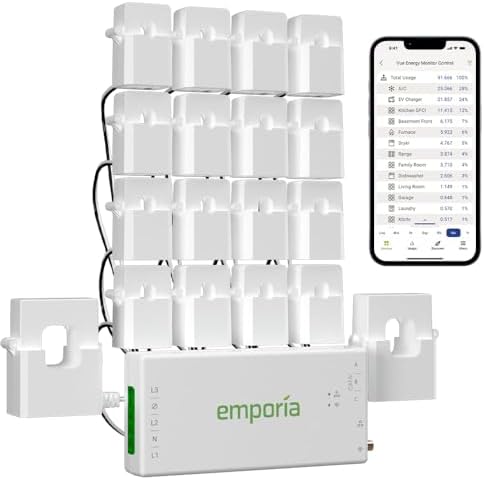
- SAFETY YOU CAN TRUST WITH UL CERTIFICATION: With Emporia Energy, your home energy monitoring is safe, reliable, and cert…
- INSTALLS IN CIRCUIT PANEL of most homes with clamp-on sensors. Supports Single phase, Single-split phase, and 2-wire sys…
- 24/7 ENERGY MANAGEMENT AND MONITORING: Automate, manage and control your home’s real power anywhere, anytime to prevent …
Emporia Vue 3 Home Energy Monitor – Smart Home Automation Module and R
🌿 Get Your Eco-Swaps Delivered Free
Try Amazon Prime free for 30 days — fast free delivery on sustainable essentials, plus Prime Video and more. Cancel anytime.
Start Your Free Prime TrialAs an Amazon Associate we earn from qualifying purchases.