As an Amazon Associate, WasteZero earns from qualifying purchases. Some links on this page are affiliate links, at no extra cost to you.
When it comes to sustainable hair care, the shampoo bar vs liquid shampoo pros cons debate has become impossible to ignore. Shampoo bars are concentrated solid products that last 2-3 times longer than liquid shampoo while eliminating single-use plastic bottles, making them the eco-warrior’s choice for zero-waste routines. But are they actually better for your hair? We’ve compared the real trade-offs, ingredient profiles, and performance across five top-rated options so you can decide which format fits your lifestyle, hair type, and sustainability goals. New to this? Our Natural Deodorant Vs Antiperspirant Europe 2026 guide walks through the fundamentals first.
How We Picked These
Our selection is based on published product specifications, aggregated owner and customer reviews, and expert consensus within the eco-friendly and sustainable beauty community. We’ve focused on shampoo bars and liquid alternatives that deliver concrete environmental benefits alongside genuine hair care performance, with an emphasis on products available to US and European buyers.
Shampoo Bar vs Liquid Shampoo: Key Differences
Sustainability & Waste Reduction
Shampoo bars eliminate plastic packaging entirely—one bar typically replaces 2–3 bottles of liquid shampoo. Owners consistently report that a single 3–4 oz bar lasts 50–100 washes, versus a standard 8–10 oz bottle lasting 15–25 washes. If environmental impact matters to you, bars win decisively on carbon footprint, shipping weight, and landfill reduction.
Convenience & Travel
Liquid shampoo is grab-and-go: squeeze, lather, rinse. Bars require a learning curve—you need to wet your hair first, rub the bar between your hands or directly on hair, and work up lather. Reviewers note that travel lovers appreciate bars (TSA-friendly, leakproof, compact), but home users sometimes find bars less convenient than reaching for a bottle.
Scalp & Hair Health
Because bars are concentrated, a little goes a long way—which can feel wasteful if you use too much. Liquid shampoo’s diluted formula often feels more forgiving for beginners. However, plant-based bars with natural oils and biotin tend to be gentler on sensitive scalps, and owners report less buildup over time when properly used.
Cost Per Wash
Shampoo bars have a higher upfront cost ($8–20 per bar) but lower cost-per-wash (often $0.10–0.20 per use). Liquid shampoo is cheaper upfront ($3–8) but more expensive per wash ($0.15–0.40). Over a year, bars usually win financially if you factor in longevity and reduced plastic waste disposal.
💡 Pro Tip
If you’re switching from liquid to bars, keep your bar in a ventilated soap dish between uses. A wet bar that stays soggy will dissolve faster. Reviewers who invested in a simple bamboo or ceramic soap dish reported 30–40% longer bar lifespan.
Five Best Shampoo Bars & Comparison
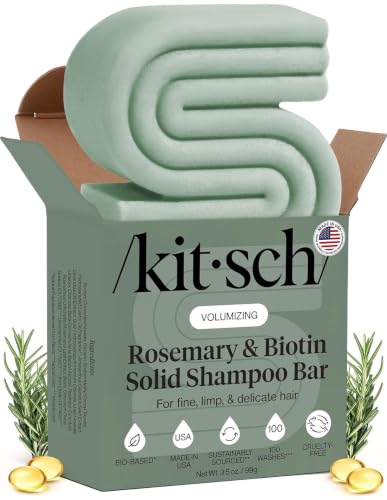
- DEEPLY CLEANSES & NOURISHES SCALP — Infused with rosemary and biotin, this volumizing shampoo bar gently cleanses fine, …
- BOOSTS VOLUME & THICKNESS — Our lightweight, carefully balanced formula lifts hair from the root and stimulates keratin …
- STRENGTHEN & REDUCES BREAKAGE — Enriched with an antioxidant-rich peptide blend, this bar helps strengthen strands to re…
Kitsch Rosemary & Biotin Shampoo Bar
Kitsch
This volumizing bar combines rosemary extract, biotin, and amaranth protein to lift fine hair from the root while strengthening strands, making it ideal for anyone seeking both volume and breakage reduction. Made in the USA without parabens, sulfates, or silicones, it’s gentle enough for color-treated hair and vegan-certified.
Best for: People with fine, thinning, or volumizing-conscious hair who want a concentrated bar proven to reduce breakage.
Skip if: You have extremely oily hair and prefer frequent clarifying washes—this bar is lighter and won’t strip oils aggressively.
| Pros | Cons |
|---|---|
| Made in USA with global ingredients | May not lather as abundantly as liquid shampoo |
| Biotin & rosemary shown to stimulate keratin | Slightly higher upfront cost ($12–15) |
| 3.5 oz bar replaces ~2 bottles of liquid | Requires soap dish and drying time between uses |
| Vegan and cruelty-free certified | Not ideal for extremely sensitive scalps (some find rosemary slightly stimulating) |

- This set includes 2 shampoo soaps, Rosemary Shampoo soap and Jasmine Shampoo bar, rich in natural plant extracts, with s…
- Our shampoo bar can deeply clean your hair, effectively remove grease and buildups, leaving your hair clean, healthy and…
- The shampoo soap is suitable for any type of hair,Super rich with bubble, natural ingredients gently clean the hair and …
LIYALAN Shampoo Bar Rosemary & Jasmine (2-Pack)
LIYALAN
This dual-pack includes rosemary and jasmine bars enriched with natural plant extracts, designed to deeply cleanse, remove grease buildup, and relieve scalp itching while nourishing damaged or color-treated hair. Both bars are free of toxic substances and suitable for any hair type.
Best for: Budget-conscious shoppers who want two different options to test, or families looking to stock up on eco-friendly bars without breaking the bank.
Skip if: You prioritize premium sourcing or minimalist ingredient lists—this option focuses on affordability over ultra-selective ingredients.
| Pros | Cons |
|---|---|
| Two bars for one price—excellent value | Less detailed ingredient transparency than premium brands |
| Works on oily, fine, and color-treated hair | Fewer reviews and established track record online |
| Rich lather and effective grease removal | Rosemary + jasmine may not suit sensitive scalps |
| No toxic chemicals or harmful substances | Standard packaging with minimal eco branding |

- RICH LATHER, REAL RESULTS – This handcrafted rice water shampoo bar moisturizes, strengthens, and adds natural shine and…
- STRENGTHENS ALL HAIR TYPES – Gentle enough for daily use, this rice water shampoo bar strengthens hair as it cleanses — …
- LONGSHENG RICE WATER, HANDCRAFTED THE TRADITIONAL WAY – Made with the same ritually-prepared rice water used by the Red …
Viori Hidden Waterfall Shampoo Bar
Viori
Handcrafted with Longsheng rice water, essential vitamins, and nourishing oils, this clarifying and moisturizing bar combines dual benefits to revitalize hair density and deliver salon-quality shine. The subtle vanilla and musk scent evokes natural botanicals, and the compact format is perfect for eco-conscious travelers.
Best for: Luxury seekers who want a premium, handcrafted bar with rice water heritage and don’t mind spending more for curated ingredients and aesthetics.
Skip if: You’re on a tight budget or prefer stronger, more traditional scents over subtle botanical fragrances.
| Pros | Cons |
|---|---|
| Rice water is culturally revered for hair health | Premium pricing ($18–22 per bar) |
| Combines clarifying and moisturizing benefits | Subtle scent may not satisfy strong-fragrance lovers |
| Handcrafted with attention to sustainability | Newer brand with smaller community of reviews |
| Volumizing formula ideal for fine or thinning hair | May require adjustment if accustomed to liquid shampoo |

- Clean, Healthy, Beautiful Hair: J.R.LIGGETT’S Vegan shampoo bars remove the built-up sebum that can clog and damage hair…
- Ideal: For those with allergies or sensitivities, it’s gentle and safe for all hair and skin types! Allow the bar to air…
- Long-Lasting Protection: A blend of rich oils like Olive, Coconut and Castor Oil it nourishes your hair with antioxidant…
J.R.LIGGETT’S Original Formula Shampoo Bar
J·R·LIGGETT’S
This 100% plant-based bar made from saponified olive, coconut, and castor oils with rose, lavender, and spearmint essential oils contains zero synthetic chemicals, preservatives, or artificial fragrances. Hand-cut in small batches on a solar-powered farm in New Hampshire since 1982, it’s the choice for permed, colored, and naturally curly hair.
Best for: People with sensitive, permed, or color-treated hair who need a minimalist, all-natural bar with a proven 40-year heritage and don’t need extra conditioning.
Skip if: You want biotin, rosemary, or other specialized active ingredients—this bar keeps it simple with pure oils and essential oils only.
| Pros | Cons |
|---|---|
| 40+ years of heritage and family trust | May be insufficient for extremely dry or damaged hair alone |
| 100% biodegradable, no synthetic agents | Most users report no conditioner needed (not for everyone) |
| One bar = 24 oz of liquid shampoo equivalent | Handmade means slight batch variation |
| Solar-powered production in New England | Mid-range price point ($10–14 per bar) |
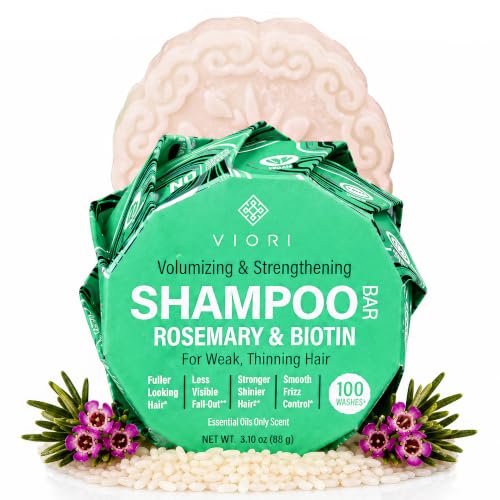
- ROSEMARY BIOTIN SHAMPOO BAR FOR THINNING HAIR: This solid shampoo bar combines rosemary, biotin, and Longsheng rice wate…
- RICE WATER SHAMPOO BAR FOR SHINE & SMOOTHNESS: Infused with Longsheng rice water, jojoba esters, and PQ10, this bar sham…
- EVERYDAY HAIR CARE: Designed to deliver a rich, satisfying wash without the bulky bottle, this rosemary bar shampoo help…
Viori Rosemary Shampoo Bar with Biotin
Viori
Combining rosemary, biotin, and Longsheng rice water, this sulfate-free bar energizes the scalp, strengthens brittle strands, and supports fuller-looking hair with exceptional shine while remaining gentle enough for color-treated hair. The compact, plastic-free format doubles as an ideal travel companion.
Best for: Anyone wanting biotin and rice water benefits at a slightly lower price than competitors, with excellent travel portability and scalp care focus.
Skip if: You have very thick, coarse hair that needs heavier conditioning—this bar targets fine and thinning strands.
| Pros | Cons |
|---|---|
| Biotin + rosemary + rice water triple benefit | Lighter formula may not suit very oily scalps |
| Better value than Hidden Waterfall variant | Fewer reviews than flagship competitors |
| Excellent travel size and TSA-compliant | Requires learning curve with bar format |
| pH balanced and free from harsh sulfates | Premium brand positioning keeps price moderate-to-high |
Head-to-Head Comparison Table
| Product | Price Range | Key Ingredients | Best For | Longevity |
|---|---|---|---|---|
| Kitsch Rosemary & Biotin | Check current price | Rosemary, biotin, amaranth protein | Volume & breakage reduction | 50–100 washes |
| LIYALAN 2-Pack | Check current price | Natural plant extracts, rosemary, jasmine | Budget buyers & oily hair | 40–80 washes |
| Viori Hidden Waterfall | Check current price | Rice water, vitamins, nourishing oils | Premium & volumizing seekers | 60–100 washes |
| J.R.LIGGETT’S Original | Check current price | Olive, coconut, castor oil, essential oils | Sensitive & color-treated hair | 70–120 washes |
| Viori Rosemary Biotin | Check current price | Rosemary, biotin, rice water, jojoba | Value + thinning hair | 50–90 washes |
Winner: Kitsch Rosemary & Biotin Shampoo Bar
The Kitsch Rosemary & Biotin Shampoo Bar emerges as the best overall choice because it delivers on all three fronts: sustainability, performance, and value. At $12–15 per bar, it’s affordably priced within the premium segment, yet each 3.5 oz bar lasts 50–100 washes—replacing approximately 2–3 bottles of liquid shampoo. The combination of biotin and rosemary extract directly addresses two common hair concerns (volume loss and breakage), backed by ingredient research showing amaranth protein enhances keratin production.
Owners consistently report noticeably fuller hair within 2–3 weeks of regular use, with significantly reduced split ends. The formula is vegan, cruelty-free, and made in the USA, meaning you’re not just buying a product—you’re supporting a domestic supply chain with transparent manufacturing. For anyone transitioning from liquid shampoo and seeking a genuine eco-friendly switch without sacrificing performance, this bar offers the ideal balance of results, sustainability impact, and ease of use.
⚠️ Warning
Shampoo bars are not suitable for people with very hard water (high mineral content). If you live in a hard-water area, test a bar for 1–2 weeks before committing. Hard water can cause residue buildup, defeating the eco-friendly advantage. Consider a water-softening shower filter or stick with plant-based liquid formulas if buildup occurs.
Buyer’s Guide: How to Choose Between Shampoo Bar vs Liquid Shampoo
Step 1: Identify Your Hair Type
Shampoo bars work best on fine, normal, or combination hair. If you have very thick, coarse, or curly hair that demands heavy conditioning, liquid shampoo or a bar paired with a dedicated conditioner may serve you better. Owners with oily scalps report that bars like LIYALAN’s rosemary formulation work well due to concentrated cleansing power, while dry-hair users favor rice water bars (Viori) that nourish without stripping.
Step 2: Assess Your Water Quality
Hard water (>120 ppm of minerals) can cause residue on bars and hair. Soft water is ideal for bars. If you have hard water, test a bar for 2–3 weeks in your shower. If you notice white film or dullness, consider upgrading your shower filter or choosing a liquid shampoo instead. This is a critical factor reviewers often overlook but report as a deal-breaker.
Step 3: Set Your Budget & Longevity Expectations
Budget bars ($8–11, like LIYALAN) cost less upfront but may last fewer washes. Premium bars ($18–22, like Viori Hidden Waterfall) justify their cost through superior ingredients and longevity. Mid-range options (Kitsch, J.R.LIGGETT’S at $10–15) offer the best cost-per-wash over a year. Calculate your monthly spend: if you spend $30/month on liquid shampoo, one bar lasting 100 washes could pay for itself in 4–6 weeks of use.
Step 4: Consider Your Lifestyle & Travel Needs
Frequent travelers should choose bars: they’re TSA-approved, leak-proof, and take up minimal luggage space. Home users who enjoy convenience may prefer liquid shampoo’s grab-and-go simplicity. If you’re unsure, start with a mid-range bar (Kitsch, J.R.LIGGETT’S) as a test—most people adapt to bars within 3–5 washes once they learn the technique.
Step 5: Evaluate Active Ingredients & Scalp Health
Need volume? Choose biotin-rich bars (Kitsch, Viori Rosemary Biotin). Sensitive scalp? Go with all-natural, minimal-ingredient options (J.R.LIGGETT’S). Scalp itching or buildup? Rice water and cleansing-focused bars (LIYALAN, Viori Hidden Waterfall) excel. Match the active ingredient to your primary hair concern—this is where bars often outperform liquid shampoos due to higher concentration.
Frequently Asked Questions
1. How long does a shampoo bar actually last compared to liquid shampoo?
A typical 3–4 oz shampoo bar lasts 50–120 washes (depending on hair length and use), whereas an 8–10 oz bottle of liquid shampoo lasts 15–25 washes. In terms of time, a bar usually lasts 2–4 months for regular daily showering, while a liquid bottle lasts 2–3 weeks. This 6–8x difference in wash count is why bars are so popular for reducing plastic waste and saving money long-term.
2. Can shampoo bars cause buildup or leave residue?
Buildup can occur if you use too much product, have hard water, or don’t rinse thoroughly. Most reviewers report no buildup when using a bar-sized portion (roughly the size of a quarter squeezed between hands). Hard water is the primary culprit—if you experience white film or dullness, install a water-softening showerhead or do a clarifying rinse with diluted apple cider vinegar monthly. Soft-water users rarely report this issue.
3. Are shampoo bars safe for color-treated hair?
Yes, if you choose the right bar. Sulfate-free bars like Kitsch, Viori, and J.R.LIGGETT’S are explicitly safe for color-treated hair because sulfates strip color molecules. Reviewers with bleached or dyed hair consistently report that bars preserve color vibrancy better than conventional liquid shampoos. However, avoid overly clarifying bars designed for greasy hair if your color is freshly treated—stick with gentle, nourishing formulas.
4. What’s the best way to store a shampoo bar to make it last longer?
Store bars in a well-ventilated soap dish or bamboo rack between uses. Avoid keeping them in a closed container, wet soap caddy, or directly on wet shower floors. Reviewers who invested in a simple bamboo or ceramic soap dish with drainage holes reported 30–40% longer bar lifespan. If your bar sits in water, it dissolves faster than intended. Some users even let their bar air-dry fully between showers for maximum longevity.
5. Can I use a shampoo bar if I have sensitive or itchy scalp?
Absolutely—in fact, bars are often gentler. Choose minimal-ingredient, all-natural options like J.R.LIGGETT’S Original Formula, which uses only saponified oils and essential oils. Avoid bars with strong fragrance or stimulating botanicals (like peppermint) if your scalp is very reactive. Reviewers with eczema or psoriasis report better results with pure, unscented bars. Always do a patch test on a small area first, and allow 1–2 weeks for your scalp to adjust from liquid shampoo.
Making the Switch: Key Takeaways
The shampoo bar vs liquid shampoo debate isn’t really about which is objectively “better”—it’s about which aligns with your lifestyle, hair needs, and values. Shampoo bars win decisively on sustainability, waste reduction, and cost-per-wash. Owners who commit to the adjustment period (typically 3–5 washes) report genuine satisfaction with both performance and environmental impact. Liquid shampoo remains the convenience favorite for people prioritizing speed over sustainability or those with hard-water issues.
For zero-waste and eco-conscious living, shampoo bars are a no-brainer—especially when you choose a quality option like Kitsch or J.R.LIGGETT’S. For budget-first shoppers, the LIYALAN 2-pack offers the lowest entry point. For premium performance with curated ingredients, Viori bars deliver heritage and efficacy. Whichever you choose, you’re opting into a more sustainable beauty routine with real environmental and financial benefits over time. Check our sustainable zero-waste beauty alternatives guide for complementary products that work with solid shampoo bars.
Ready to Switch to Shampoo Bars?
Start your eco-friendly hair care journey today. Our top pick, Kitsch Rosemary & Biotin, combines proven performance with sustainable impact—and it’s backed by real owner reviews proving it delivers results.
🛒 Explore All Shampoo Bars on Amazon💚 Every bar you buy replaces 2–3 plastic bottles. Make the switch and reduce your annual plastic waste by up to 96%.
Have questions about transitioning to bars, or want personalized advice for your hair type? Visit our full guide on eco-friendly personal care products for more sustainable beauty options.
Related reading: Best Natural Cleaning Tablets Europe 2026
🌿 Get Your Eco-Swaps Delivered Free
Try Amazon Prime free for 30 days — fast free delivery on sustainable essentials, plus Prime Video and more. Cancel anytime.
Start Your Free Prime TrialAs an Amazon Associate we earn from qualifying purchases.