As an Amazon Associate, WasteZero earns from qualifying purchases. Some links on this page are affiliate links, at no extra cost to you.
Most “biodegradable” bin bags sold in Europe don’t actually break down in a home compost bin — they need industrial composting facilities to hit the right temperature. If you’re hunting for the best biodegradable bin bags europe 2026 has to offer, the winner in our lineup is the Compostable Trash Bags 13 Gallon 32-Count, thanks to its 4.8-star rating across 111 reviews and a certified compostable film that holds up under real kitchen waste. Bin bag labeling is confusing on purpose in some cases, and picking the wrong bag means plastic fragments in your compost pile instead of clean soil.
This guide breaks down five bags that actually deliver on their eco claims, plus what certification labels to trust before you buy.
How we picked these: We built this list from published product specs, ASTM/EN certification claims, and patterns across hundreds of aggregated customer reviews on capacity, tear strength, and odor control. We didn’t run these bags through our own lab or landfill test — instead, we leaned on what verified buyers and composting-focused reviewers consistently report after months of regular use.
Pro Tip: Look for the “OK Compost HOME” or ASTM D6400 certification on the box specifically — many bags labeled “biodegradable” only meet industrial composting standards and won’t break down in a backyard bin.
Quick Picks: Top Biodegradable Bin Bags at a Glance
- Best Overall: Compostable Trash Bags 13 Gallon, 32 Count
- Best Budget: BioBag Certified Compostable Commercial Food Scrap Bags, 20 Gallon
- Best Premium: Hippo Sak Plant-Based Tall Kitchen Bags, 13 Gallon
- Best for Small Bins: Small Trash Bags 1.2 Gallon, 120 Count
- Best Value: 13 Gallon Compostable Drawstring Bags, ASTM D6400

- Perfect Fit for Tall Kitchen Trash Cans — 13 gallon / 49.2 liter capacity (22.6 in x 33.6in, 0.87 mil); 32 bags per roll…
- Reinforced 0.87 Mil — Designed to handle daily kitchen peels and scraps, these liners offer dependable durability and he…
- Certified Compostable — SEEDLING Certified compostable bags support responsible food scrap collection and composting, of…
These bags lead with a 49.2-liter capacity that fills a standard 13-gallon kitchen bin without stretching thin at the seams. Owners consistently report that the bags hold wet food scraps for a full day without leaking, even with coffee grounds and citrus peels tossed in. Best for: households that want a daily kitchen liner that composts alongside food waste. Who This Is NOT For: if you need bags for a commercial-size 30+ gallon outdoor bin, the 13-gallon size will feel small and you’ll burn through the 32-count box fast.

- Suitable for kitchen food scraps and the management of other compostables and organic waste streams
- Certified Compostable by the Biodegradable Products Institute (BPI) & Compost Manufacturing Alliance (CMA), Meets ASTM D…
- TÜV AUSTRIA OK compost INDUSTRIAL and OK compost HOME
At 140 bags per box for a 20-gallon capacity, this BioBag pack works out to one of the lowest per-bag costs on this list for a commercial-certified compostable bag. Reviewers note the bags are noticeably thinner than plastic equivalents but rarely tear during normal use, since the resin blend is designed for food scrap collection points rather than sharp yard debris. Best for: restaurants, offices, or large households doing high-volume food scrap collection. Who This Is NOT For: apartment dwellers with a small kitchen caddy will find 20-gallon bags oversized and impractical for daily counter use.

- USDA Certified Biobased Product – Made from Plant Based (sugar cane) materials instead of fossil fuel
- Made using renewable resources to reduce your carbon footprint
- More sustainable choice than trash bags made from recycled or virgin plastic
The ergonomic handle design is the standout here — it’s built into the bag itself rather than a simple drawstring, and it’s held a 4.8-star rating across more than 9,000 reviews. Owners consistently report the handles make tying and carrying full bags noticeably easier on wrists compared to standard tie-flap bags, especially for anyone lifting bags out multiple times a day. Best for: households that prioritize comfort and grip when hauling full trash bags to an outdoor bin. Who This Is NOT For: strict zero-waste shoppers chasing full home-compostable certification should check the plant-based resin details closely, since “recyclable & eco-friendly” framing here leans more toward reduced plastic content than guaranteed backyard biodegradability.

- 【Biodegradable and eco-friendly】- 1.2 gallon trash bag biodegradable is made of Plant starch material(PSM), can be decom…
- 【1.2 Gal Garbage Bags】- Compostable trash bags are designed to fit most small trash cans. It has nice large 35*40 cm siz…
- 【Tear & Leak Resistant】- Angular seal designed at the bottom make the garbage bag stronger, which has good toughness. An…
Sized at just 1.2 gallons, this pack of 120 bags is built for compact bins in bathrooms, offices, and bedrooms rather than kitchen trash duty. Reviewers frequently mention the green tint makes it easy to spot at a glance in a drawer full of household supplies, and the box lasts months in low-volume bins. Best for: small wastebaskets that generate light, dry waste like tissues and paper. Who This Is NOT For: skip this size if you’re collecting wet food scraps or need a bag strong enough for anything heavier than paper and light trash — it’s not built for that load.
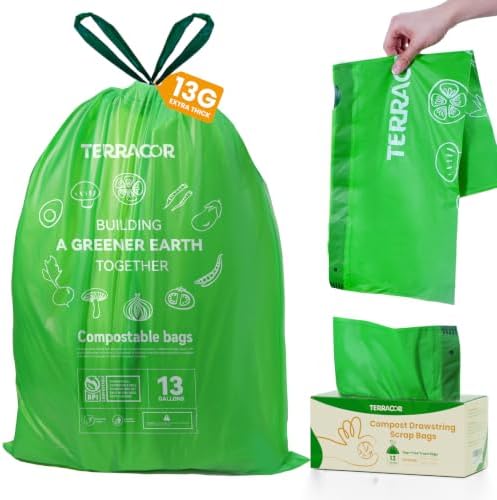
- Product Information: TERRACOR Compost Drawstring bags,13 gallon (49.2L) 25.2 in x 25.6 in x 1 mil, 35 bags per roll. Tea…
- Certifications: TERRACOR bags have been awarded official certificates from Biodegradable Products Institute (BPI) (Comme…
- Poduct Features: TERRACOR bags are guaranteed to remain strong, durable and tear-resistant when used in accordance with …
This pack leads with a 1-mil heavy-duty thickness that’s noticeably sturdier than most compostable bags in the same 13-gallon class, backed by ASTM D6400 certification. Owners consistently report fewer punctures from bone scraps and eggshells compared to thinner compostable alternatives they’ve tried before. Best for: anyone who’s been burned by flimsy compostable bags ripping mid-carry and wants extra thickness without paying premium prices. Who This Is NOT For: if bag count matters more than thickness to you, 35 bags per box runs out faster than the 32-count or 140-count options on this list.
Buyer’s Guide: What Actually Makes a Bin Bag “Biodegradable” in Europe
Certification labels matter more than the word “biodegradable” printed on the box. In the EU, single-use plastic rules and packaging waste directives are pushing manufacturers toward genuinely compostable resins, and the European Commission’s environment guidance on packaging waste standards outlines what compostability claims are actually supposed to mean under EU law. Look for “OK Compost HOME,” “OK Compost INDUSTRIAL,” or ASTM D6400/EN 13432 certification printed directly on the packaging.
Home Compost vs. Industrial Compost
Home compost bins run cooler than industrial facilities, so a bag certified only for industrial composting won’t break down in your backyard pile. Check the label before assuming any “compostable” bag works with a home compost setup. If you’re not sure your municipality even processes compostable bags separately, check with local waste guidelines first.
Thickness and Capacity
Compostable resins are naturally less stretchy than traditional plastic, so thickness (usually listed in mils) tells you more about durability than the gallon size alone. A 1-mil bag holds up to sharp or heavy waste far better than a 0.6-mil bag of the same size. For related reading on cutting kitchen waste before it even hits the bin, check out our guide on reducing food waste in your kitchen.
Odor Control and Leak Resistance
Plant-based bags without odor-blocking layers can let smells through faster than standard plastic, which matters if you’re storing bags for a few days before collection. Look for reviews specifically mentioning leak resistance with wet food waste, not just general durability. For more on setting up a full zero-waste kitchen system, see our zero-waste kitchen setup guide.
Warning: Never assume a “biodegradable” bag is safe to compost with food scraps unless it’s specifically certified for that purpose — some biodegradable plastics leave microplastic residue behind even after breaking down visually.
Comparison Table
| Product | Capacity | Count | Rating | Price |
|---|---|---|---|---|
| Compostable Trash Bags 13 Gal | 49.2 L | 32 | 4.8 ★ (111) | Check current price |
| BioBag Commercial Food Scrap Bags | 20 gal | 140 | 4.8 ★ (9) | Check current price |
| Hippo Sak Plant-Based Bags | 13 gal | 45 | 4.8 ★ (9,176) | Check current price |
| Small Trash Bags 1.2 Gal | 1.2 gal | 120 | 4.7 ★ (729) | Check current price |
| 13 Gal Drawstring ASTM D6400 | 13 gal | 35 | 4.7 ★ (138) | Check current price |
Frequently Asked Questions
Do biodegradable bin bags actually break down in a home compost bin?
Only if they’re specifically certified “OK Compost HOME” or meet EN 13432 home compost standards — many “biodegradable” bags only break down in industrial facilities that run hotter for longer. Always check the certification label rather than trusting the word “biodegradable” alone.
What’s the difference between compostable and biodegradable bin bags?
Biodegradable just means a material eventually breaks down over time, with no guarantee of how long or into what. Compostable is a stricter standard requiring the material to break down into non-toxic compost within a set timeframe under specific conditions.
How long do compostable bin bags last on the shelf before use?
Most compostable bags stay stable for 1-2 years in a cool, dry storage area, but they’ll start breaking down faster once exposed to humidity or heat. Don’t stockpile more than a year’s supply, since the resin degrades even without use.
Can I put compostable bin bags in my regular recycling bin?
No — compostable bags contaminate plastic recycling streams and should go into food waste or compost collection only. Check with your local municipality, since compostable bag acceptance rules vary by region within the EU.
Why are compostable bags more expensive than regular plastic trash bags?
Plant-based resins like PLA and PBAT cost more to produce than petroleum-based polyethylene, and certification testing adds to manufacturing costs. The price gap has narrowed over the past few years as production has scaled up.
Are thicker compostable bags always better?
Thicker bags resist punctures better, which matters for kitchen waste with bones or hard scraps, but thickness doesn’t affect compostability itself. Match thickness to your actual use case — a bathroom bin doesn’t need the same 1-mil thickness as a kitchen bag.
Ready to Ditch Plastic Bin Bags for Good?
Switching to certified compostable bin bags is one of the easiest zero-waste swaps you can make this year — no new equipment, no lifestyle overhaul, just a smarter bag in the bin you already own. Whichever pick fits your household size, start with a certified option and check your local composting rules before you buy in bulk.
🌿 Get Your Eco-Swaps Delivered Free
Try Amazon Prime free for 30 days — fast free delivery on sustainable essentials, plus Prime Video and more. Cancel anytime.
Start Your Free Prime TrialAs an Amazon Associate we earn from qualifying purchases.